





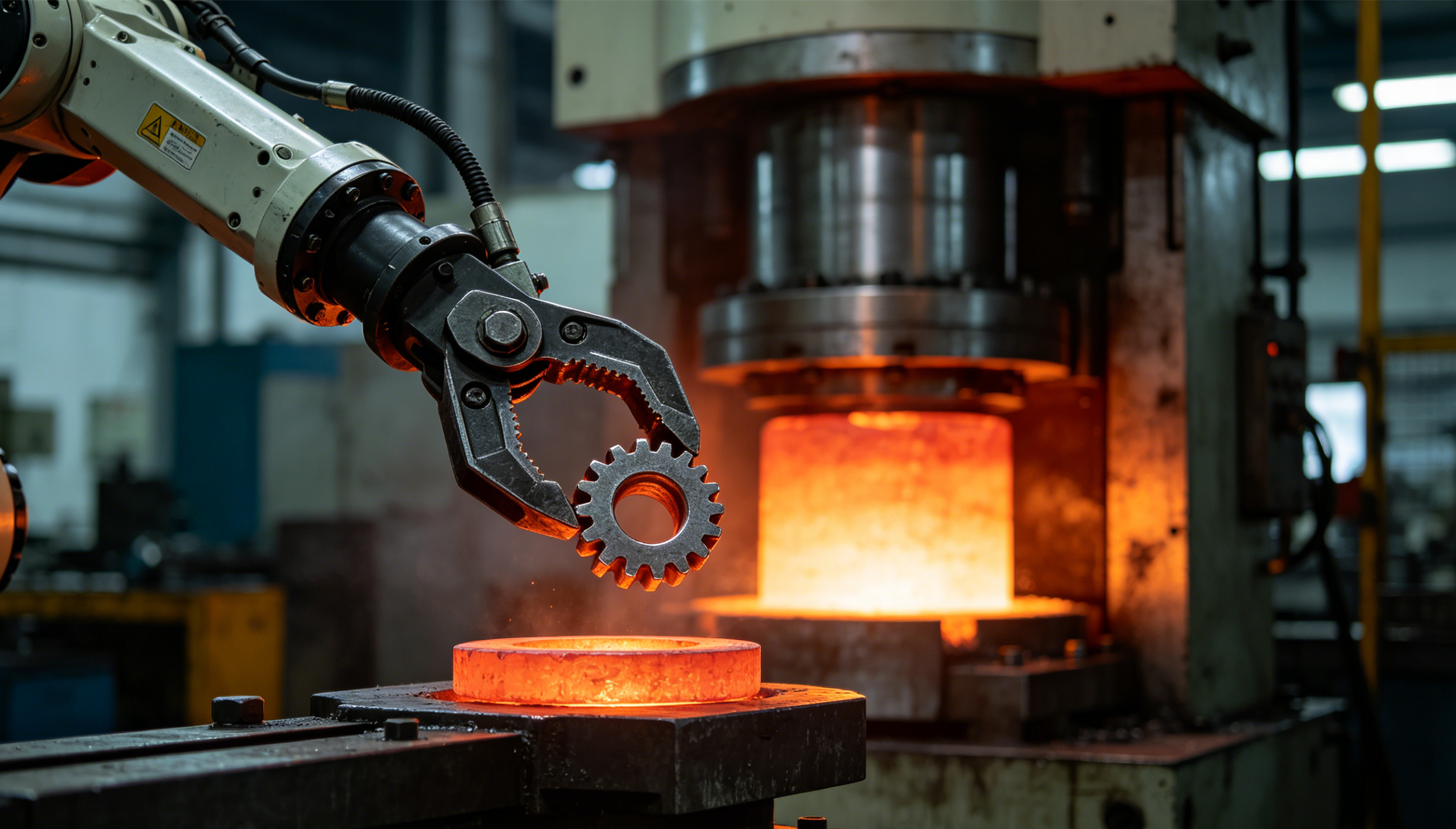
What is Hot Die Forging? Process, Advantages, and Industrial Applications
Hot die forging is one of the most reliable and widely adopted metal forming processes in modern industrial manufacturing. As a core branch of hot forging technology, it shapes metal materials under high temperature and precise die pressure, producing high-strength, defect-free metal components for heavy-duty industries. Unlike casting, machining, or cold forging, hot die forging optimizes the internal grain structure of metals, delivering superior mechanical performance, structural stability, and fatigue resistance.
To help engineers, procurement teams, and manufacturing enthusiasts fully understand this classic process, this blog will elaborate on the definition, complete hot forging manufacturing process, core advantages, industrial applications, and the key differences between forged steel and cast steel.
What is Hot Die Forging?
Hot die forging is a precision metal forming manufacturing process that heats metal billets above their recrystallization temperature (typically 1100°C–1250°C for carbon steel and alloy steel) and places the softened metal into customized closed or semi-closed forging dies. Under continuous high pressure from forging hammers or hydraulic presses, the metal flows completely to fill the die cavity, forming finished parts with fixed shapes and precise dimensions.
Different from open die forging for simple rough parts, hot die forging focuses on mass production of precision complex components. The high-temperature environment eliminates metal work hardening, improves material plasticity, and allows the metal grain flow to follow the geometric contour of the part. This fundamentally eliminates internal defects such as pores, shrinkage cavities, and loose structures, greatly improving the overall quality of metal parts.
Complete Hot Forging Manufacturing Process Step by Step
The hot die forging process follows standardized and rigorous production procedures, covering raw material inspection to finished product delivery. The complete manufacturing process is as follows:
1. Raw Material Preparation & Inspection
Select qualified steel billets (carbon steel, alloy steel, stainless steel, etc.), conduct strict chemical composition and mechanical property testing, and cut the billets into fixed specifications according to part requirements to ensure consistent material quality.
2. High-Temperature Heating
Place the cut billets in an industrial heating furnace for uniform heating to the optimal recrystallization temperature. Uniform heating is the key to avoiding cracking, uneven deformation, and internal structural differences during forging.
3. Pre-forging & Final Forging Forming
Transfer the high-temperature softened billet to the forging die. Pre-forging is carried out first to distribute the metal material evenly, then final die forging is performed to make the metal fully fill the die cavity and form the complete part contour. This step determines the dimensional accuracy and surface quality of the forging.
4. Trimming & Deburring
Remove excess flash and burrs generated during die forging to make the part outline neat and consistent, laying a foundation for subsequent finishing processing.
5. Heat Treatment (Quenching & Tempering)
Forged parts undergo standardized heat treatment to eliminate forging stress, refine grain structure, and significantly improve hardness, toughness, and wear resistance, meeting the mechanical performance requirements of industrial parts.
6. Finishing & Precision Machining
Perform fine turning, grinding, and drilling on the parts to reach the final dimensional tolerance and surface roughness standards.
7. Quality Inspection & Packaging
Conduct non-destructive testing (ultrasonic inspection, magnetic particle inspection), size detection, and performance sampling inspection. Qualified products are packaged and delivered.
Core Advantages of Hot Die Forging
1. Excellent Mechanical Properties
Hot die forging refines the internal metal grains and makes the grain flow continuous along the part shape. It eliminates internal pores, shrinkage cavities, and slag inclusions common in casting parts. Forged parts feature higher tensile strength, better toughness, and stronger fatigue resistance, suitable for long-term high-load operation.
2. High Dimensional Accuracy & Repeatability
Relying on precision customized dies, hot die forging realizes standardized mass production. The dimensional error of finished parts is small, with high consistency and interchangeability, greatly reducing subsequent machining workload and production cost.
3. Strong Material Plasticity & Low Defect Rate
High-temperature heating reduces metal hardness and improves plasticity, enabling the production of complex-shaped parts that are difficult to process by cold forging and machining. It effectively avoids cracking and deformation during forming.
4. Long Service Life & High Structural Stability
The compact internal structure of hot die forgings ensures stable performance under extreme conditions such as high pressure, high temperature, and impact load, with far longer service life than cast parts.
Forged Steel vs Cast Steel: Key Differences
Many buyers confuse forged steel and cast steel in industrial procurement. The two processes have essential differences in structure, performance, and application scenarios:
1. Internal Structure & Defects
Forged Steel: Dense and uniform internal structure, no pores or shrinkage cavities, continuous grain flow, extremely low internal defect rate.
Cast Steel: Easy to produce pores, shrinkage cavities, and slag inclusions during molten steel pouring, with loose internal structure and discontinuous grain distribution.
2. Mechanical Performance
Forged Steel: Higher strength, better toughness, stronger impact resistance and fatigue resistance, not easy to deform or break under cyclic load.
Cast Steel: Low overall toughness, poor fatigue resistance, prone to brittle fracture under high impact and long-term alternating load.
3. Dimensional Accuracy & Surface Quality
Forged Steel: High dimensional precision, smooth surface, small machining allowance.
Cast Steel: Large dimensional error, rough surface, large subsequent machining workload.
4. Application Scenarios
Forged Steel: Suitable for core load-bearing parts with high safety requirements, such as automotive chassis parts, aerospace structural parts, and petroleum high-pressure accessories.
Cast Steel: Suitable for low-load, static equipment parts with low performance requirements, focusing on shape molding rather than strength.
Main Industrial Applications of Hot Die Forging
1. Automotive & Commercial Vehicle Industry
Hot die forging is the mainstream process for automotive core parts, including connecting rods, gears, transmission shafts, axle hubs, steering parts, and crankshafts. These forged parts withstand long-term cyclic load and ensure driving safety and stability.
2. Aerospace Industry
Aerospace landing gear components, engine brackets, turbine discs, and structural fasteners all adopt hot die forging. The high strength and fatigue resistance of forged steel fully meet the extreme operating requirements of aerospace equipment.
3. Petroleum & Energy Equipment
High-pressure valve bodies, drill collars, bearing rings, and power turbine blades in energy equipment are manufactured by hot die forging, adapting to high-temperature, high-pressure, and corrosion-resistant extreme working environments.
4. Construction & Engineering Machinery
Key load-bearing parts of excavators, cranes, and heavy machinery, such as hydraulic parts and connecting joints, use hot die forgings to guarantee structural stability under heavy load and impact.
Conclusion
Hot die forging is an irreplaceable high-precision metal forming process in modern manufacturing. Through standardized hot forging manufacturing procedures, it optimizes metal internal structure, solves the inherent defects of cast steel, and produces high-strength, high-precision, long-life industrial forgings. Compared with cast steel, forged steel has overwhelming advantages in mechanical performance and structural stability, becoming the preferred material for high-load and high-safety industrial core parts.
With the upgrading of industrial manufacturing, hot die forging technology will continue to be widely used in automotive, aerospace, energy, and engineering machinery fields, providing reliable component support for high-end equipment manufacturing.